

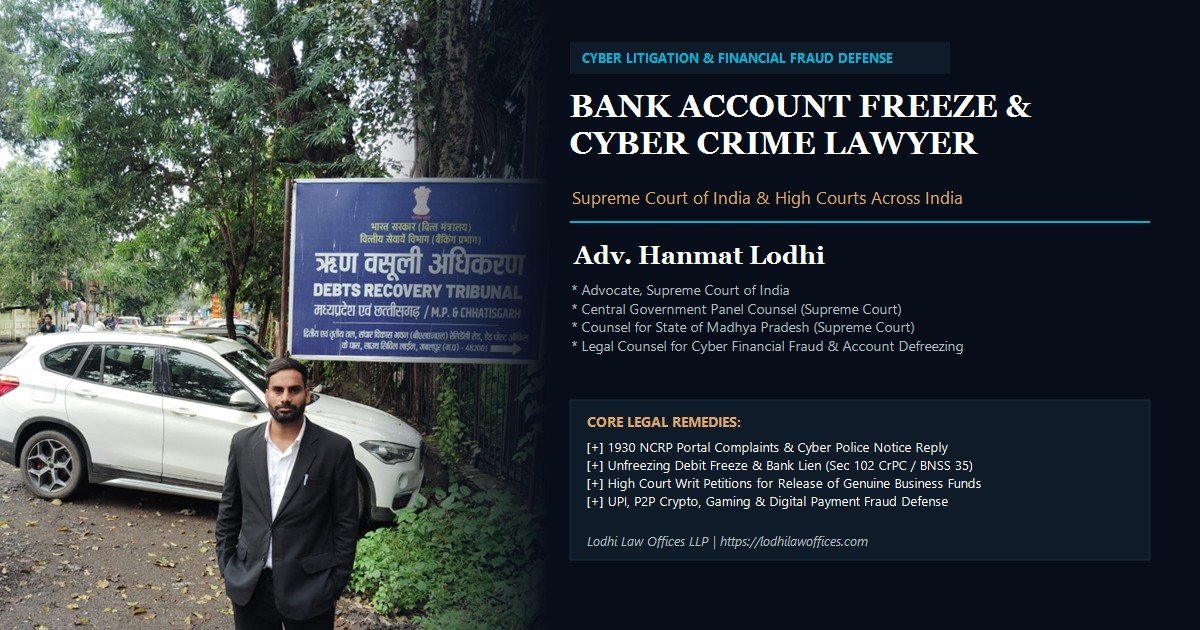
In India’s fast-expanding digital economy, cyber financial fraud and arbitrary bank account restrictions have emerged as severe legal challenges for bona fide businesses, professionals, digital traders, and individuals. Every day, thousands of bank accounts are subjected to sudden debit freezes, total account blocks, or lien markings following complaints registered on the National Cyber Crime Reporting Portal (NCRP / Helpline 1930), leaving genuine account holders unable to access their legitimate funds or conduct commercial operations.
Adv. Hanmat Lodhi, Advocate, Supreme Court of India, Member of the Supreme Court Bar Association (SCBA), Central Government Panel Counsel (Supreme Court), and Government Panel Counsel for the State of Madhya Pradesh, provides litigation and advisory representation before the Supreme Court of India, the Madhya Pradesh High Court, and High Courts across India in high-stakes cybercrime complaints, digital financial disputes, and bank account freeze litigations.
Understanding the legal procedure governing police investigations, notice compliances, and judicial remedies before Magistrates and High Courts is essential to securing the expeditious release of frozen accounts and protecting commercial reputation.
Why Was Your Bank Account Frozen? The “Layering” Process Explained
When an online financial fraud is reported (such as phishing, work-from-home scams, fraudulent investment platforms, or unauthorized payment gateway charges), investigating authorities trace the money trail across multiple banking channels:
- Layer 1 Account: The initial bank account where fraudulent proceeds were directly transferred by the victim.
- Layer 2 & Layer 3 Accounts: Intermediate bank accounts through which funds are rapidly layered or dispersed to disguise the origin.
- Layer 4 / Innocent Recipient (Your Account): A bona fide merchant, freelance service provider, P2P cryptocurrency trader (on platforms like Binance, Bybit, WazirX), or vendor who received funds in exchange for legitimate goods, digital assets, or services without knowledge of any tainted origin.
Because automated cyber cell algorithms issue blanket freezing directions, banks routinely freeze the entire account rather than restricting only the disputed transaction amount, creating immense commercial disruption.
Governing Legal Provisions: CrPC vs. Bharatiya Nagarik Suraksha Sanhita (BNSS), 2023
The authority of investigating agencies to freeze bank accounts is governed by statutory provisions that are strictly subject to constitutional safeguards:
1. Seizure of Bank Accounts: Section 102 CrPC / Section 107 BNSS, 2023
While the Supreme Court in State of Maharashtra v. Tapas D. Neogy (1999) affirmed that bank accounts constitute “property” capable of seizure under Section 102 CrPC, this power is not unbridled. Under Section 102(3) CrPC (now Section 107 BNSS), the police officer must forthwith report the seizure to the Jurisdictional Magistrate. Failure to report the freeze to the competent Magistrate vitiates the continuation of the freeze (OPTO Circuit India Ltd. v. Axis Bank).
2. Investigation Notices: Section 91 CrPC & Section 35(3) BNSS, 2023
Cyber police stations issue notices requesting KYC records, invoices, bank statements, and justifications for disputed transactions. Furthermore, notices under Section 35(3) of BNSS, 2023 (which replaces Section 41A CrPC) require formal legal appearance or written replies. Treating these notices casually or providing inconsistent factual explanations can lead to serious criminal complications.
Key Judicial Precedents on Arbitrary Bank Freezes
Constitutional courts across India have laid down strict parameters preventing arbitrary police actions:
- Lien Limited to Disputed Amount: In Dr. S. Sivasubramanian v. State and consistent rulings by the Delhi, Madras, and Gujarat High Courts, courts held that freezing an entire multi-lakh business account for a disputed transaction of a few thousand rupees is arbitrary, disproportionate, and violative of Article 19(1)(g) and Article 21. The restriction must strictly be confined to the disputed sum.
- Protection of Bona Fide Third Parties: Genuine traders and service providers who have supplied goods against valid GST invoices or proof of consideration cannot be treated as conspirators in cyber fraud.
Comprehensive Legal Services Offered by Adv. Hanmat Lodhi
- Origin Identification: Procuring the Crime Number, NCRP Acknowledgement Number, originating cyber police station details, and investigating officer (I.O.) contact from bank nodal officers.
- Legal Representations: Drafting and serving exhaustive legal representations along with transaction receipts, invoices, and bank statements to prove bona fide receipt of funds.
- Applications before Jurisdictional Magistrates (Section 451 / 457 CrPC | Section 503 BNSS): Moving formal petitions before the Magistrate having jurisdiction over the investigating police station for defreezing the account upon furnishing indemnity bonds.
- High Court Writ Petitions (Article 226): Where cyber authorities fail to respond or unfreeze accounts despite proof of innocence, filing writ petitions before the High Court for quashing arbitrary freeze orders and restoring debit operations.
- Cyber Bail & Anticipatory Protection: Providing robust representation in cases where coercive measures, summons, or false implications under cyber provisions or penal statutes are apprehended.
Action Checklist: Immediate Steps When Your Account is Frozen
- Do NOT Panic or Delete Messages: Preserve all digital communication, invoices, order confirmations, and WhatsApp/Telegram chat histories.
- Obtain Written Particulars from Bank: Request your branch manager to provide:
- Notice Reference Number and NCRP Acknowledgement Number.
- Name and state of the investigating Cyber Crime Police Station.
- Exact disputed transaction amount and date.
- Distinguish Between Total Freeze and Lien: Verify if your account has a complete debit freeze or a lien placed on a specific amount.
- Engage Specialized Legal Counsel: Issue a prompt legal response with documentary proof before the matter progresses to formal charge-sheeting.
Contact Adv. Hanmat Lodhi for Cyber Legal Representation
For urgent case evaluation, responding to cybercrime police notices, removing bank account liens, and filing High Court writ petitions:
Adv. Hanmat Lodhi
Advocate, Supreme Court of India
Member, Supreme Court Bar Association (SCBA)
Central Government Panel Counsel, Supreme Court of India
Government Panel Counsel for the State of Madhya Pradesh, Supreme Court of India
Chamber: Chamber No. 102, A.K. Sen Block, Supreme Court of India, New Delhi – 110001
Madhya Pradesh Practice: High Court of Madhya Pradesh / South Civil Lines, Jabalpur
Website: https://lodhilawoffices.com | LODHI LAW OFFICES LLP
Disclaimer: This article is intended solely for general legal awareness and educational purposes under Bar Council of India guidelines and does not constitute formal legal advice. Legal remedies depend on the specific facts, bank records, investigating agency jurisdiction, and applicable judicial orders.