

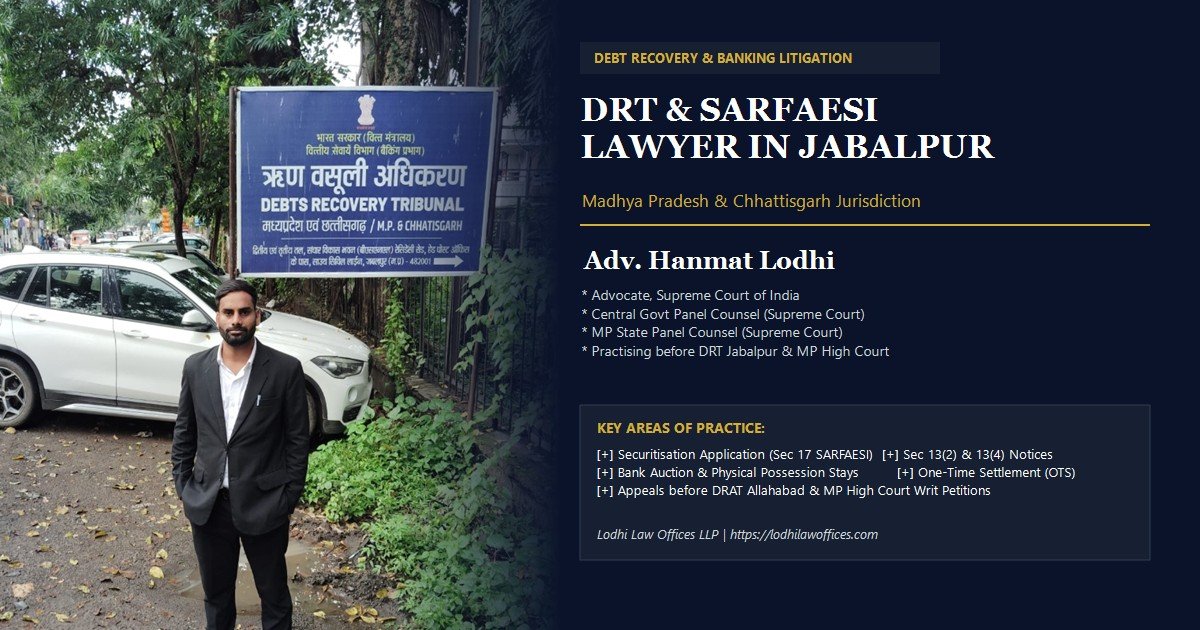
Jabalpur, Madhya Pradesh, is the premier judicial center of the state, housing the Principal Seat of the Madhya Pradesh High Court and the Debts Recovery Tribunal (DRT) Jabalpur, which exercises territorial jurisdiction across the entire state of Madhya Pradesh and Chhattisgarh. For borrowers, businesses, mortgagors, and guarantors facing aggressive debt recovery actions by banks, Non-Banking Financial Companies (NBFCs), and Asset Reconstruction Companies (ARCs), understanding available statutory remedies is vital to protecting secured assets and business continuity.
Adv. Hanmat Lodhi, Advocate, Supreme Court of India, Member of the Supreme Court Bar Association (SCBA), Central Government Panel Counsel (Supreme Court), and Government Panel Counsel for the State of Madhya Pradesh, provides dedicated litigation and advisory services before the Supreme Court of India, the Madhya Pradesh High Court at Jabalpur, and the Debts Recovery Tribunal (DRT) Jabalpur.
With a comprehensive litigation-focused approach, Advocate Hanmat Lodhi assists clients in evaluating and asserting their legal rights in matters involving loan defaults, NPA classifications, statutory recovery notices, and proceedings under the Securitisation and Reconstruction of Financial Assets and Enforcement of Security Interest (SARFAESI) Act, 2002 and the Recovery of Debts and Bankruptcy Act, 1993 (RDB Act).
DRT Jabalpur: Jurisdiction & Regulatory Framework
Bank recovery proceedings often create acute distress for borrowers, particularly when a financial institution issues a 60-day demand notice, initiates steps to take physical possession of residential or commercial property, or issues a public e-auction notice. Under Indian law, debt recovery disputes involving banks are adjudicated through specialized statutory forums:
- Debts Recovery Tribunal (DRT) Jabalpur: Situated at Sanchar Vikas Bhavan, South Civil Lines, Jabalpur, DRT Jabalpur is the sole specialized judicial authority for all debt recovery applications and SARFAESI appeals originating from all districts of Madhya Pradesh and Chhattisgarh.
- Debts Recovery Appellate Tribunal (DRAT) Allahabad: Statutory appeals against final or interlocutory orders passed by DRT Jabalpur lie before the DRAT at Allahabad under Section 18 of the SARFAESI Act or Section 20 of the RDB Act.
- High Court of Madhya Pradesh (Jabalpur, Indore, Gwalior): While statutory alternative remedies exist before DRT, writ petitions under Article 226/227 of the Constitution of India may be maintained in exceptional circumstances involving patent lack of jurisdiction, breach of natural justice, or during vacancies in the tribunal.
Core Practice Areas in DRT & Banking Litigation
DRT proceedings involve intricate technicalities surrounding mortgage deeds, statement of accounts, compound interest calculation, penal charges, valuation reports, and strict compliance with the Security Interest (Enforcement) Rules, 2002. Adv. Hanmat Lodhi provides comprehensive legal assistance in:
- Securitisation Applications (Section 17 SARFAESI): Challenging arbitrary, procedural, and illegal measures taken by secured creditors within the mandatory 45-day limitation window.
- Stay Petitions & Urgent Injunctions: Securing immediate protective orders and stays against scheduled e-auctions, dispossession, and sealing of industrial, commercial, or residential properties.
- Section 14 DM / CJM Possession Proceedings: Defending borrowers before District Magistrates and Chief Judicial Magistrates against ex-parte physical possession orders, examining statutory compliance of the bank’s mandatory 9-point affidavit.
- Defense in Original Applications (OA under Section 19 RDB Act): Representing borrowers and corporate guarantors in recovery suits instituted by banks for amounts exceeding ₹20 Lakhs.
- Exemption of Agricultural Land (Section 31(i)): SARFAESI Act strictly exempts agricultural land from enforcement. Challenging illegal notices issued by banks against agricultural properties.
- One-Time Settlement (OTS) Negotiation & Structuring: Legally vetting and drafting OTS proposals to ensure binding settlement, prevention of future claims, timely release of original title deeds, and issuance of No Dues Certificates (NDC).
SARFAESI Act, 2002: Key Stages and Statutory Remedies for Borrowers
The powers vested in secured creditors under the SARFAESI Act are sweeping, but they are strictly circumscribed by statutory prerequisites. Any non-compliance by the bank provides maintainable grounds for challenge before DRT Jabalpur:
1. Demand Notice under Section 13(2) & 60-Day Notice Period
Upon classification of an account as NPA, the lender issues a 60-day demand notice. The borrower has the statutory right under Section 13(3A) to submit a formal representation or objection. The secured creditor is legally obligated to examine the objection and communicate a reasoned response within 15 days. Failure by the bank to deliver a reasoned rejection vitiates all subsequent enforcement steps (Mardia Chemicals Ltd. v. Union of India).
2. Possession Notice under Section 13(4)
If dues remain unpaid after 60 days, the lender may issue a possession notice taking symbolic or physical possession. This constitutes a “measure” under the Act, giving the borrower or any aggrieved third party exactly 45 days to file a Securitisation Application before DRT Jabalpur under Section 17.
3. Bank Auction and Sale Notice Challenges
Proposed e-auctions of secured assets carry severe consequences. Under Rule 8(6) and Rule 9(1) of the Security Interest (Enforcement) Rules, 2002, the bank must serve an individual 30-day notice to the borrower prior to the first sale and publish public notices in two leading newspapers. Substantial undervaluation of property or failure to obtain an updated valuation from an approved valuer are strong grounds for seeking an immediate auction stay.
Borrower Action Plan Upon Receiving a Bank Notice
- Preserve All Records: Retain the original notice, postal envelopes, tracking slips, loan sanction letters, and complete account ledgers.
- Strictly Monitor Deadlines: Note the statutory limitation periods—15 days for Section 13(3A) representations, and 45 days for filing Section 17 Securitisation Applications.
- Verify Interest & NPA Classification: Examine whether penal interest capitalization, uncredited subsidies, or arbitrary rate revisions contributed to default.
- Seek Early Legal Scrutiny: Intervene before the auction sale is finalized or third-party rights are created.
Professional Legal Consultation & Chamber Details
For strategic case evaluation, review of bank notices, and legal representation before the Debts Recovery Tribunal (DRT) Jabalpur, the High Court of Madhya Pradesh, and the Supreme Court of India, contact:
Adv. Hanmat Lodhi
Advocate, Supreme Court of India
Member, Supreme Court Bar Association (SCBA)
Central Government Panel Counsel, Supreme Court of India
Government Panel Counsel for the State of Madhya Pradesh, Supreme Court of India
Supreme Court Chamber: Chamber No. 102, A.K. Sen Block, Supreme Court of India, New Delhi – 110001
Jabalpur Office: South Civil Lines / High Court of Madhya Pradesh, Jabalpur
Law Firm: LODHI LAW OFFICES LLP | https://lodhilawoffices.com
Disclaimer: This publication is published solely for educational and general legal awareness purposes in adherence to Bar Council of India guidelines. It does not constitute formal legal advice. Available legal remedies depend on the specific loan documentation, factual matrix, limitation periods, and applicable judicial precedents.